
The River-Chapter33
The Morning Shift
Laura was carrying a bucket of weeds toward the compost pile when she heard the chickens objecting to something near the house. She stopped and listened. Their ordinary conversations had become familiar over the summer: the muttering that accompanied a search beneath the shrubs, the considerable announcement of an egg, the dissatisfied remarks made when she appeared without anything worth eating. This was different.
The Doberman came around the corner first, looking pleased with himself. Behind him, a hen ran with her wings half open, followed by two others who seemed to have joined the emergency without understanding it.
“Leave them.”
The dog stopped. The chickens continued another few yards before remembering that they could scatter.
Laura set down the bucket. He stood watching her, alert and handsome, his expression suggesting that she had interrupted a useful activity. He had never caught a chicken. Laura suspected this was largely because catching one would spoil the game.
“Come here.”
He approached readily enough, though he looked back once to see whether the entertainment might continue without him. She took his collar and walked him to the house.
The six hens had arrived that season as small, improbable creatures who needed warmth and supervision. Now they occupied the property with a confidence Laura admired. They investigated every disturbed patch of soil, followed her shovel, and occasionally stationed themselves directly where she intended to put her foot. She had expected eggs. She had not expected to acquire an audience.
At the back door, she let the dog inside and latched the pet door. He turned to look at her.
“You’ve lost outside privileges.”
His ears remained upright. He had apparently heard only the word outside.
She went back for the weeds.
The morning had begun cool, but sunlight was reaching across the garden now. Beyond the fence, junipers stood against a pale sky, and the air carried the dry smell that rose when she brushed their branches. Five acres had seemed manageable when she bought the place. It was still manageable, provided she accepted that some portion of it would always be waiting.
The old deck had been one of the first things she removed. Several boards were soft, the steps had begun to lean, and the structure occupied a sunny patch she wanted to use differently. Taking it apart had proved easier than carrying it away. She had worked through a succession of afternoons, pulling nails, stacking lumber, and discovering that a board became substantially heavier between the house and the disposal pile.
The patio that replaced it lay warm in the sun. She liked its plainness, the solid ground beneath the chairs, and the way she could walk out with a cup and stay a while without noticing another loose railing. Along one edge, plants she had put in herself were beginning to fill the spaces she had left for them.
A few old junipers had gone too. She had done that work in stages, taking down what she could handle and leaving herself room to retreat. The stumps remained. Sometimes she regarded them as future projects. Sometimes she put a flowerpot on one.
Her phone sounded in her pocket.
Peter wanted to know whether she had seen his latest message.
Laura looked toward the house. It was still early here, though the East Coast had moved well into its day. Before breakfast she had reviewed a document, answered two questions, and sent back a third because it required information nobody had included. She had closed the laptop intending to spend an hour outside.
She typed that she would look shortly, then put the phone away.
The weeds went onto the compost pile. When she returned to the garden, one of the hens had climbed into the empty bucket. Laura waited while it considered its position.
“Take your time.”
The hen stepped out, leaving behind something Laura had not requested.
Inside, the dog was standing in the hallway with his head lowered.
Laura stopped at the door.
He looked up at her, then down again.
The cat sat a few feet away, composed and attentive. Between them, beneath the narrow table where Laura kept her keys, something moved.
“Oh, no.”
The cat had brought things through the pet door before. Some were dead, which Laura disliked. Others were alive, which required a degree of participation she disliked more.
A mouse appeared beside the table leg, saw the dog, and disappeared beneath the shoe rack.
Laura closed the door behind her.
“Everybody out.”
The dog came immediately. The cat remained where it was.
Laura opened the door again, moved the dog onto the porch, and closed it before he could reconsider. Then she picked up the cat, who accepted this intervention with the stiffness of someone being removed from a meeting.
Outside, she set it down beside the dog.
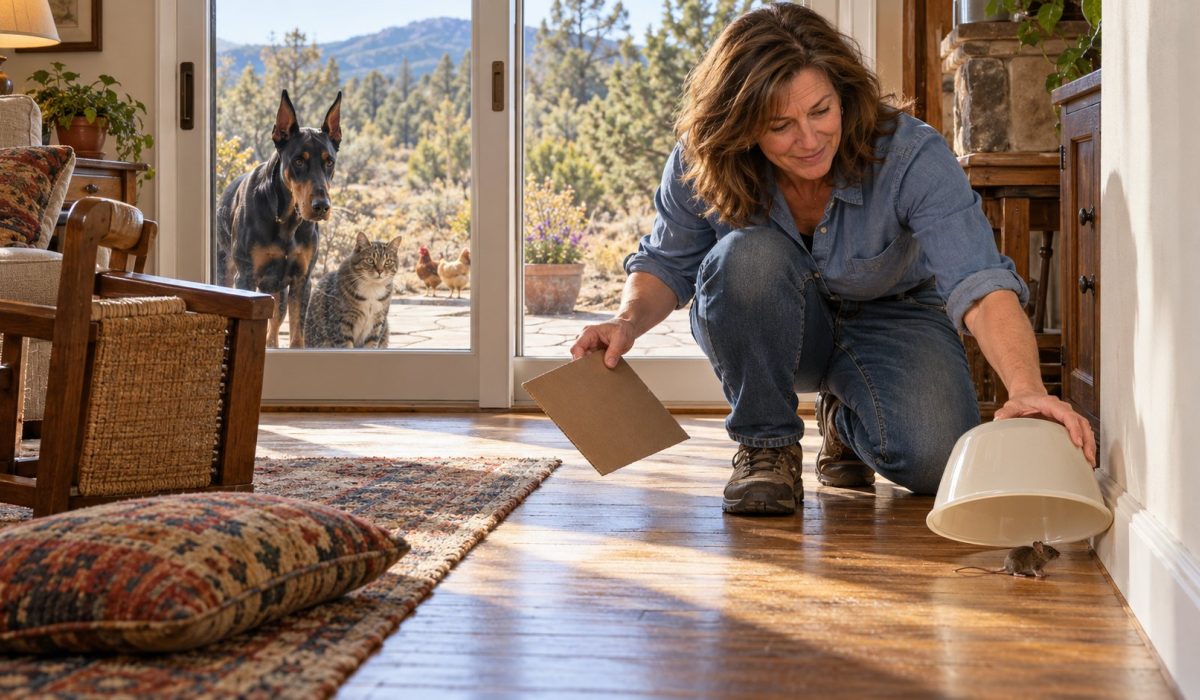
The two of them looked through the glass while she went to find a container.
By then the mouse had moved.
Laura stood quietly in the hallway, holding a plastic mixing bowl and a piece of cardboard. The house seemed unusually still. She could hear the refrigerator, a bird outside, and then her phone.
She let it ring.
A small movement beneath the bench gave the mouse away. Laura crouched, placed the bowl where she thought it might run, and reached behind the bench with the cardboard.
The mouse went in the opposite direction.
It crossed the hallway, passed her left shoe, and disappeared into the living room.
Laura remained crouched for a moment.
On the porch, the dog pressed his nose to the glass.
“I know,” she told him. “You could make this worse much faster.”
She followed the mouse.
It took twenty minutes, the movement of two chairs, and an arrangement of cushions that would have been difficult to explain to a visitor. Once, she thought she had it beneath the bowl, only to discover that she had captured a curled leaf brought in on someone’s foot. Eventually the mouse made the mistake of choosing a corner with no furniture in it.
Laura lowered the bowl.
For a moment she knelt with her hand on top, feeling the small movements beneath the plastic. Then she slid the cardboard under it, rose carefully, and carried the assembly outside.
She released the mouse near a pile of branches well away from the house. It vanished into the cover so quickly that she barely saw it leave.
When she returned, the cat had settled in a patio chair.
Laura looked at it. “You’re welcome.”
Peter answered her call with a question about the document.
She had washed her hands, found her coffee, and opened the laptop. The coffee was cold. The document had acquired three new comments since she last saw it.
“I’m looking now,” she said.
He explained what had changed. She listened, scrolling slowly, until she reached a paragraph that appeared to have been inserted during the explanation.
“Who added this?”
There was a pause.
“I think Martin.”
“Does Martin know we’re agreeing to it?”
“He wrote it.”
“That isn’t quite the same thing.”
They worked through the paragraph. Peter was impatient, though not with her specifically. His impatience filled whatever space was available. There was a meeting later, a decision someone needed before it, and a belief that the remaining difficulties could be settled if everyone would concentrate.
Laura concentrated.
She asked for a figure, waited while he found it, and changed the wording to reflect what they actually intended. Then she read the sentence aloud.
“Yes,” Peter said. “That’s what I meant.”
She left a brief silence before answering. “Good.”
By the time they finished, the hour she had planned for the garden was gone.
Peter asked whether she could stay available.
Laura looked through the window. The hens were beneath the juniper near the patio, industriously clearing a patch of ground she had planted only the week before.
“For another half hour,” she said. “After that, I’ll check again this afternoon.”
He began to describe the meeting. She listened long enough to understand what he might need, then repeated when she would be back.
When the call ended, she sat at the desk without touching the keyboard.
She liked the work. That sometimes made it harder to stop. There was nearly always something she could improve, clarify, or prevent, and the people asking knew she would take it seriously. Working from home had removed the drive between office and house. It had also removed the interval in which nobody could reasonably expect her to answer.
Outside, a hen stepped into the flower bed.
Laura closed the laptop.
She returned to the garden with a length of wire fencing and several stakes. The hens gathered to inspect the installation. One tried to enter the bed while she was fastening the last section, and Laura lifted it out with both hands.
For the next hour she worked steadily. The dog, restored to the outdoors under supervision, lay in the shade with his chin on his paws. Whenever a chicken passed, his eyes followed it. Laura occasionally said his name without looking up.
She transplanted two crowded plants, watered the seedlings, and pulled weeds from around the tomatoes. There was satisfaction in finishing a row and seeing what she had done.
At noon she took lunch onto the patio. Her shoulders ached pleasantly. She had dirt along one wrist and a small scratch she could not remember acquiring.
The cat slept in the other chair.
After eating, Laura went inside and sat at the piano. She began with a piece she knew well, playing slowly until her hands settled. At a passage she often hurried, she stopped and tried it again. The second time, she let the notes take their full measure.
Through the open window came the faint scrape of a hen moving soil.
She continued playing.
When she finished, the dog was lying across the doorway. She stepped over him and found her phone on the kitchen counter. There were messages waiting, but also one from Kate.
Ride tomorrow? Sensible distance.
Laura stood by the window and considered the weather.
Yes, she wrote. You choose the route.
A reply arrived almost immediately.
In writing. Excellent.
Laura smiled, put the phone down, and went to collect the eggs.
Posted in the-river by Geoff Stevens